Hormonal Insomnia in Women: Why You Can't Sleep Before Your Period
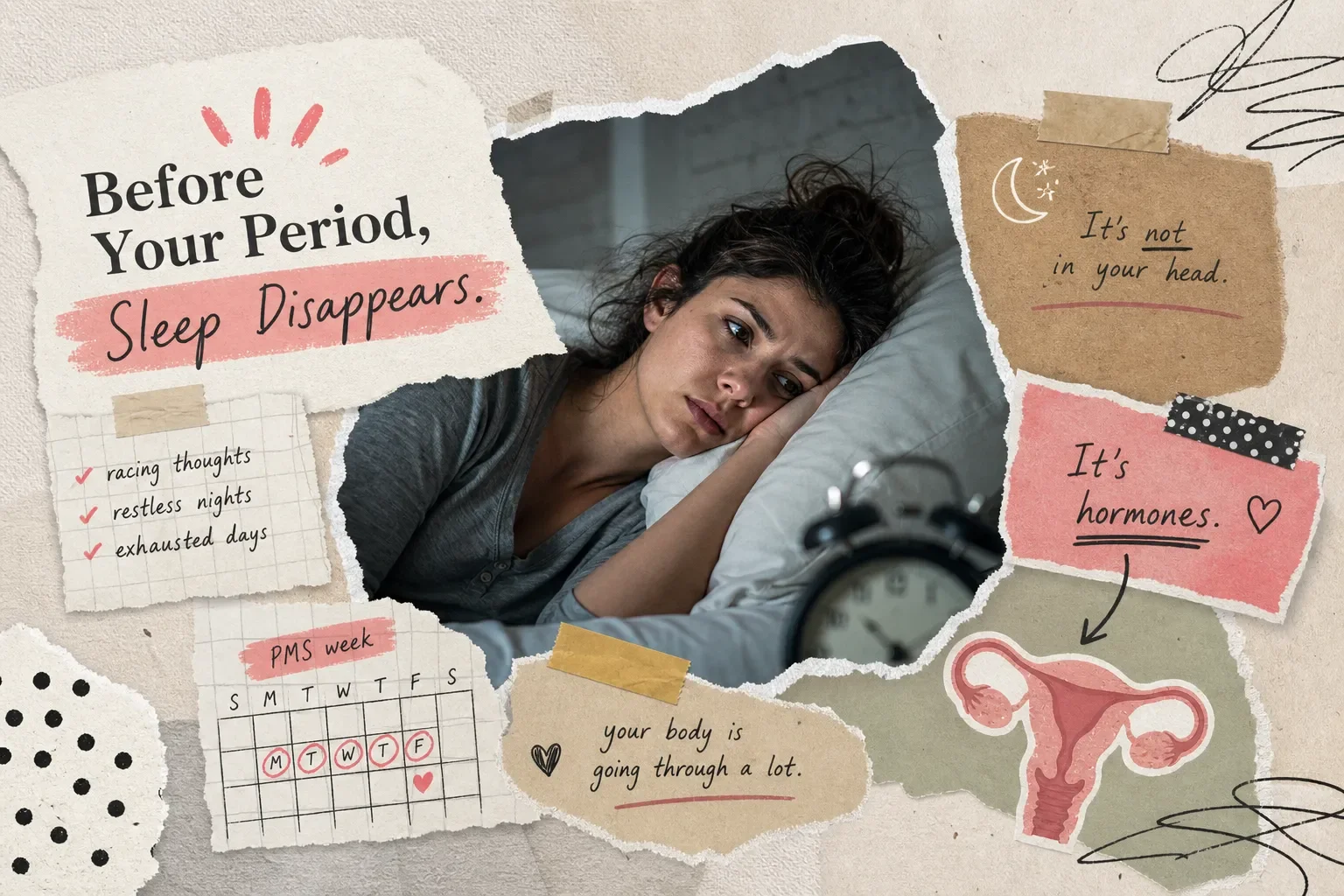
Many women experience insomnia in the week before their period and quietly chalk it up to stress, too much screen time, or just a rough patch. But if your sleeplessness shows up like clockwork, arriving in the days before your period and clearing up once your cycle moves on, it isn't random. It follows a pattern, and that pattern is hormonal.
This article covers two distinct presentations of hormonal sleep disruption: the difficulty falling and staying asleep that many women experience in the late luteal phase, and the very different kind of night waking that emerges in perimenopause. Understanding which one you're dealing with changes everything about how you approach it. This is precisely the kind of pattern that a practitioner specialising in women's hormonal health is trained to identify and address at the root, rather than paper over with generic advice.
Why your insomnia worsens in the week before your period
The progesterone-sleep connection explained
Progesterone does more than prepare the uterus for a potential pregnancy. Through its conversion to a neurosteroid called allopregnanolone, it acts on GABA receptors in the brain. GABA is your nervous system's main calming chemical, and allopregnanolone amplifies its effect, creating a more settled, sleep-supportive internal environment during the mid-luteal phase when progesterone is at its peak.
The late luteal phase is a different story. In the days before menstruation, progesterone falls sharply, and allopregnanolone falls with it. The calming effect your body had been relying on disappears, and the nervous system loses its hormonal buffer against arousal. For women who are sensitive to this shift, the result is noticeable: the mind feels harder to quieten, and sleep feels further away than it did a week ago.
How the late-luteal phase disrupts sleep architecture
The hormonal withdrawal of the late luteal phase doesn't just make it harder to fall asleep. It affects the quality of sleep you do get. Women in this phase often experience lighter, more fragmented sleep, with less of the deep slow-wave sleep that leaves you feeling genuinely restored in the morning.
This shows up alongside other familiar late-luteal symptoms: heightened anxiety, physical restlessness, and temperature sensitivity that can make staying comfortable feel like its own challenge. The sleeplessness isn't a character flaw or a stress problem. It's a direct physiological response to a hormonal shift that happens on a predictable schedule, every single month.
What perimenopausal insomnia actually looks like
Oestrogen, cortisol, and the 3 a.m. wake-up
Perimenopausal sleep disruption has a different signature. Where late-luteal difficulty sleeping is primarily a sleep-onset insomnia problem, perimenopausal night waking is a sleep-maintenance insomnia problem. Women often describe waking sharply at 2 or 3 a.m., fully alert, sometimes with a racing heart, and then lying in the dark unable to return to sleep for an hour or more.
The mechanism here involves oestrogen's role in regulating the HPA axis, which controls your body's stress hormone response. As oestrogen fluctuates and declines, cortisol rhythms become less stable overnight and the stress system becomes more reactive. Vasomotor symptoms like hot flushes and night sweats compound this directly: a physical jolt of heat wakes the body, cortisol rises in response, and sleep architecture fragments further. When this pattern persists across multiple cycles or months without a clear resolution, it begins to resemble chronic insomnia rather than a transient hormonal blip.
How to tell whether your insomnia is cyclical or perimenopausal
The clearest distinguishing feature is predictability. Cycle-linked sleep disruption tracks tightly with the luteal phase and resolves once menstruation begins. If you sleep better in the first half of your cycle and worse in the second, that's a meaningful signal. Perimenopausal night waking is less orderly: it can occur regardless of where you are in your cycle, it often accompanies irregular cycles, and the waking pattern tends to be more persistent.
Some women in the perimenopause transition experience both simultaneously, with worsening late-luteal insomnia symptoms layered onto unpredictable overnight waking. Understanding which pattern dominates, or whether both are present, shapes what kind of support will actually be useful for you.
Nutrition strategies that support sleep through the luteal phase
Blood sugar stability in the luteal phase
Progesterone reduces insulin sensitivity in the second half of the cycle, which means blood sugar becomes less stable than it was in the week prior. When blood glucose drops overnight, the body releases cortisol to bring it back up. That cortisol release can pull you out of deep sleep or prevent you from settling in the first place, which is why erratic evening eating patterns tend to worsen late-luteal sleep disruption.
The practical implication is straightforward: what you eat in the evening matters more during your luteal phase than at other times of the month. Prioritise protein and healthy fats at dinner, and avoid high-sugar snacks in the hours before bed. If waking overnight is a consistent pattern, a small protein-containing snack before sleep, such as a handful of nuts or a few slices of cheese, can help keep blood glucose stable through the night.
Key nutrients that help the body wind down
Magnesium has the clearest nutritional evidence for sleep support. Magnesium glycinate in particular appears to have a modest but meaningful effect on sleep onset, likely because magnesium supports GABA function and helps regulate nervous system activity. Food sources include dark leafy greens, pumpkin seeds, and dark chocolate. As a supplement, magnesium glycinate is generally well tolerated, but personalising the dose with a practitioner is worth doing rather than starting high and guessing.
Tryptophan-rich foods, including turkey, eggs, and oats, provide the raw material for serotonin and melatonin production. The mechanism is plausible, and the foods are worth including as part of your evening meals during the luteal phase. Vitamin B6, found in salmon, chickpeas, and bananas, supports neurotransmitter synthesis. Think of these nutrients as supporting your body's existing pathways rather than replacing anything. Food first, targeted supplementation second, and always with an eye on what your individual picture actually needs.
Nervous system and behavioural approaches that actually move the needle
Why standard sleep hygiene misses the hormonal piece
Generic sleep hygiene advice isn't wrong. Some of it has a solid evidence base. But applying it uniformly across your cycle misses the point. In the late-luteal phase, your baseline nervous system arousal is higher than it was two weeks ago, and the same wind-down routine that worked then may feel inadequate now.
Two behavioural habits have the strongest evidence base regardless of cycle phase: using the bed for sleep only (stimulus control), and keeping your morning wake time consistent even after a poor night. These are also core components of CBT-I, or Cognitive Behavioural Therapy for Insomnia, which is recognised as first-line treatment for chronic insomnia by sleep medicine guidelines. Morning light exposure within the first hour of waking helps regulate your circadian rhythm and has a measurable downstream effect on sleep quality that same night. Anchor these habits before adding anything else.
Regulating a luteal-phase nervous system
The late-luteal hormonal environment creates physiological hyperarousal. The nervous system is more sympathetically activated, more reactive to stimuli, and less able to shift into the parasympathetic state that supports sleep onset. Standard relaxation advice often underestimates how much deliberate effort this shift requires during this phase.
Extended-exhalation breathwork is one of the better-supported tools: a 4-count inhale followed by a 6-to-8-count exhale activates the vagal brake and moves the nervous system toward parasympathetic dominance. Even 10 to 15 minutes of this before sleep has been shown to reduce sleep-onset latency. Yoga nidra, a guided body-awareness and relaxation practice, offers a similar reset and is particularly accessible for women whose minds are already racing. A warm bath or shower taken 60 to 90 minutes before bed also has solid evidence behind it: the subsequent drop in core body temperature mirrors the natural thermal cue for sleep onset, making the transition easier.
Mapping your cycle is the first step to understanding your insomnia
How tracking your cycle reveals sleep patterns
There's something quietly clarifying about seeing a pattern on paper that you've only ever felt in your body. When you begin noting sleep quality, how long it takes to fall asleep, whether you wake overnight, and how you feel in the morning alongside your cycle day or phase, the picture becomes legible. After two to three cycles, most women can identify a clear window where their sleep deteriorates and when it reliably improves.
This data isn't just useful for self-understanding. It becomes genuinely valuable in a clinical consultation, giving a practitioner a concrete picture of how your hormonal patterns are affecting your sleep, energy, and mood across the month rather than relying on a vague summary of how things have "generally been."
Working with a practitioner who specialises in hormonal patterns
If you've recognised your own experience in this article, working with someone who understands the hormonal drivers of sleep is a logical next step. Naomi Judge is a naturopath who works specifically in women's hormonal health. Her approach addresses late-luteal sleep disruption, cyclic mood symptoms, and perimenopausal transitions through a naturopathic, root-cause lens. Rather than managing symptoms in isolation, she helps women understand what their cycle is actually doing and where the hormonal picture needs support through nutrition, targeted supplementation, and cycle literacy education.
If you're not yet sure where to start, Naomi offers a free Cycle Mapping Cheat Sheet that provides a simple framework for tracking your symptoms, sleep quality, and cycle phase together. It's a practical first step you can take before booking a consultation, and it means you arrive with real data rather than a vague sense that something is off.
Where to go from here
Your sleep disruption isn't random, and it isn't something you should simply learn to live around. If it follows a monthly rhythm, arriving in the week before your period or pulling you awake in the middle of the night as you move through perimenopause, that rhythm is communicating something specific about your hormonal health.
The two patterns covered in this article have different drivers and different solutions. Late-luteal difficulty sleeping responds to nutritional support, blood sugar stability, and nervous system regulation. Perimenopausal night waking calls for a different lens, one that accounts for oestrogen fluctuation, HPA axis reactivity, and vasomotor symptoms. Treating both the same way consistently falls short.
Starting to track your cycle is the simplest, most revealing thing you can do right now. It costs nothing and it transforms vague suffering into visible, actionable data. If your insomnia has followed a monthly pattern and you're ready to understand why rather than just endure it, the answer is in your cycle. Hormonal insomnia, however relentless it feels, has real mechanisms behind it, and real mechanisms have real solutions.